
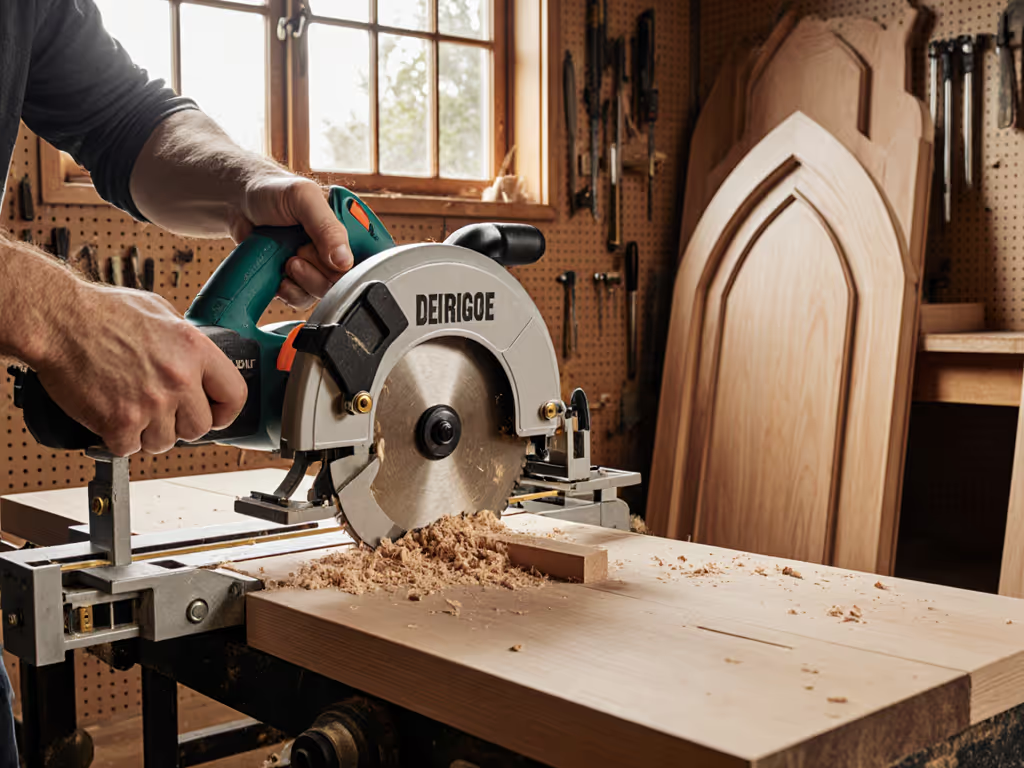
Circular Saw Blade Geometry: Physics to Predictable Cuts
By Luca Pereira • 19th Feb

When a blade wanders through a crosscut, tears out the veneer on plywood, or burns through a sheet mid-stroke, the culprit is rarely the saw itself (it's the mismatch between tooth geometry and task). Circular saw blade tooth geometry defines how each tooth is shaped, angled, and positioned to cut specific materials, and understanding it is the fastest way to eliminate waste, guesswork, and the rework anxiety that costs more than the blade ever will.
Most of us buy "the blade that fits" without asking what it's designed to do. The result: splintered edges that need sanding, slow feed rates that tire the arm, motor bogging under load, and sheet goods damaged before they ever reach the workbench. Tooth configuration impact isn't academic: it's the difference between a first-try clean cut and a callback, a finished edge and a mulligan that burns time and material.
I learned this the hard way on a weekend built-in. I grabbed a bargain combo blade for speed, hit birch ply with it, and watched the teeth chip edges and devour the surface. Two hours of rework and a replacement sheet later, I understood: the problem wasn't the saw or my technique. It was buying a blade by price instead of purpose. Since then, I quantify blade value as cost per accurate, clean cut (factoring in tool price, material loss, time, and the anxiety of knowing what's coming). Price matters, but waste and rework cost more.
The Problem: Blade Confusion Masquerades as Tool Confusion
Walk into a tool shop and you'll find circular saw blades labeled ATB, FTG, TCG, HLTCG (alphabet soup that means nothing if you're in a hurry). You need a blade. What you actually need is the right blade for birch plywood, or pressure-treated framing lumber, or a glue-line trim cut. The blade aisle doesn't ask those questions. So you either grab the most teeth (assuming finer is better) or the cheapest (assuming price reflects capability), and then curse the results on site.
The pain compounds. On plywood or veneer, tear-out ruins the visible face. For field-proven methods to stop splintering, try our tear-out prevention guide. On hardwood, burn marks appear mid-cut if feed rate doesn't match tooth geometry. On composite materials or metal, a general-purpose blade chatters or glazes the edge. Each wrong choice costs time (setup, test cuts, chasing answers) and material, because sheet goods are expensive and mistakes are permanent.
Understanding Tooth Geometry: Geometry Predicts Performance
Every circular saw blade falls into one of four core tooth shapes, each optimized for a specific cutting physics. Knowing the geometry tells you what that blade will do before you plug it in.
ATB (Alternate Top Bevel) teeth are angled alternately left and right, like a row of knife blades tilted in opposite directions[1]. The bevel angle typically ranges from 10 to 20 degrees. This geometry slices grain cleanly rather than chopping it, which is why ATB blades excel at crosscuts (cuts perpendicular to grain in wood and plywood)[1]. The angled approach minimizes tear-out on visible edges. Most ATB blades carry 40+ teeth, creating smaller chip loads per tooth and finer surface finish. Trade-off: ATB teeth dull faster than flat teeth because the thin, angled geometry is more fragile under load[4].
FTG (Flat Top Grind) teeth have square-top edges perpendicular to the blade body, attacking wood like a chisel chops[1][4]. They work fast and leave the blade durable, so you can push hard without fear of tooth breakage. But the trade-off is surface finish; FTG blades leave a rougher cut because each tooth is ripping rather than slicing[1][4]. This geometry dominates rip cuts (cuts along the grain in solid wood) where speed and durability matter more than mirror polish[1][4].
TCG (Triple-Chip Grind) alternates trapezoidal teeth with flat teeth. The trapezoid tooth (typically beveled 45 degrees on both sides) roughens the cut; the following flat tooth cleans it like a rake[1][4]. This combination is engineered for dense, hard materials: laminates, solid-surface countertops, non-ferrous metals[1][4]. It reduces heat buildup and edge pull-out because neither tooth punches as aggressively as in an all-ATB or all-FTG design.
Combination geometries, such as ATB+R (four ATB teeth plus one flat "rake" tooth) or HLTCG (high-low trapezoid-flat), blend the benefits of multiple shapes. Four ATB teeth do the cutting work; the following rake tooth cleans the groove, resulting in fast, clean cuts that work for both crosscuts and rip cuts in wood[1]. These are often labeled "all-purpose" because they sacrifice peak performance in any single task but deliver reliable results across materials and directions[1].
Hook Angle, Clearance, and the Physics of Feed
Tooth geometry is only half the story. The angle at which teeth engage the material (called hook angle, or rake angle) controls how aggressively the blade pulls itself into the cut. For a deeper dive into why hook and clearance angles control tear-out and vibration, see our material tear-out physics explainer.
Positive hook angles (typically 10 to 22 degrees) tilt the tooth forward, pulling the blade into the material quickly[3]. This feeds fast and reduces cutting effort, making positive hook ideal for soft woods and fast ripping where you want throughput[3]. The downside: positive hook can cause chatter or tear-out on brittle materials or veneered surfaces because the aggressive entry stresses the grain.
Neutral or negative hook angles (0 to 6 degrees) push back slightly against forward momentum, giving the operator finer control[3]. This geometry suits crosscuts in hardwoods or plywood, where tear-out is a concern, and it's safer for unmanned or guided cuts because the blade won't dive if clamping slips[3].
Clearance angles (the small relief behind and beside each tooth) prevent friction and heat buildup. Top clearance (12 to 15 degrees) lets the tooth's trailing edge clear the cut without rubbing the surface[3]. Side clearance (1 to 2 degrees) tapers each tooth slightly, minimizing drag[3]. These tiny angles protect the carbide tip and keep the blade cool. Insufficient clearance causes burning; excessive clearance weakens the tooth or introduces vibration[3].
Matching Geometry to Material: The ROI Framework
Clean cuts that stay on line and don't require rework come down to one decision: blade geometry must match material and cut direction.
- Crosscutting plywood or veneer? ATB geometry, 40+ teeth, neutral or slightly negative hook. The slicing action and fine-toothed approach preserve the veneer surface.
- Ripping solid wood? FTG or FTG-heavy combination, 24 to 40 teeth depending on speed vs. finish preference. Accept a rougher surface (it's behind you), and you're maximizing throughput and blade durability.
- Cutting laminates, solid surface, or soft metals? TCG or HLTCG. These geometries reduce heat and chatter in dense, brittle materials where finish matters and material is expensive.
- Mixed tasks or all-purpose work? Combination geometry (ATB+R or similar). Sacrifice peak performance in any single task, but avoid the cost and complexity of owning a blade for every material.
Price matters, but waste and rework cost more.
This is where scenario math takes over. A $40 all-purpose blade that tears out plywood edges, requiring sanding or replacement, isn't cheaper than a $65 ATB blade that cuts glue-ready in one pass. The real cost isn't the blade price (it's blade price plus material loss, rework time, and the anxiety of knowing what you're buying into).
The Predictability Payoff
When you stop treating tooth geometry as a curiosity and start treating it as a performance spec, your cuts become predictable. You know why a blade will perform a certain way before you make the cut. You can buy once, cry never, because you're not guessing.
The next time you reach for a blade, ask three questions: (1) What material am I cutting? (2) Which direction (with or across the grain)? (3) How important is finish vs. speed? Those answers point directly to tooth geometry. ATB for clean crosscuts, FTG for fast rips, TCG for dense or composite materials, combination for flexibility.
Take five minutes before your next job to match geometry to task. Track one cut: note the feed rate, the sound, the edge quality, the time. Compare it to a mismatched blade from a previous project. That gap (cleaner edge, faster feed, less vibration, zero burn) is the ROI. Do that enough times, and blade choice stops being overwhelming and becomes automatic.
Your next cut is already waiting. Make it count.
Related Articles


Must-Have Circular Saw Add-Ons for Repeatable Precision Cuts
Learn how track guides, quick-set rip systems, negative-hook blades, and dust extraction make circular-saw cuts consistent and glue-ready. Includes setup guidance and real-world performance benchmarks to improve accuracy, speed, and control.